Homeschool Dance Curriculum: Build a Full Year of Dance
Homeschool Dance Curriculum: How to Build a Full Year of Dance Education
If you have ever wanted to add dance to your homeschool but were not sure how to turn it into a structured, year-long subject, you are not alone. Dance is one of the most rewarding activities you can weave into a homeschool routine -- but going from "my kid likes to dance" to "we have a real homeschool dance curriculum" can feel like a big leap.
It does not have to be. With a clear plan, the right resources, and a realistic schedule, you can build a dance curriculum that keeps your child physically active, creatively engaged, and progressing through real skills all year long. This guide walks you through how to do exactly that.

Why a Structured Dance Curriculum Matters
Random dance videos and occasional freestyle sessions are fun, but they are not a curriculum. A structured approach matters for several reasons.
Real skill development. Dance is a progressive discipline. A child who follows a sequenced curriculum -- where each lesson builds on the last -- will develop technique, body awareness, and confidence far more effectively than one who jumps between unrelated videos. Just like math or reading, dance skills compound over time.
Easier documentation. If you plan to count dance toward PE credit, fine arts credit, or both, having a structured curriculum makes record-keeping straightforward. You can log hours, track completed lessons, and point to measurable progress when documenting your homeschool year.
Consistency and habit. Children thrive with routine. When dance has a regular place in your weekly schedule -- rather than being something you do "when we have time" -- it becomes a sustainable part of your homeschool life rather than an afterthought.
Step 1: Set Goals for the Year
Before choosing a program or mapping out a schedule, start by thinking about what you want your child to get out of a year of dance education. Your goals do not need to be elaborate. Here are some examples:
Exploration goal: "My child will try at least two dance styles this year and discover what they enjoy."
Skill-building goal: "My child will complete a full beginner course in ballet, learning foundational positions, basic barre work, and simple choreography."
PE credit goal: "My child will complete 120 hours of structured physical activity through dance to satisfy our state's PE requirement."
Fine arts goal: "My child will earn one fine arts credit through dance, documented with lesson logs and completed coursework."
Your goals will shape everything else -- which styles to study, how many hours per week to schedule, and what kind of program to use.
Step 2: Choose Dance Styles by Age and Interest
One of the best things about building a homeschool dance curriculum is that you are not locked into a single studio's offerings. Your child can explore multiple genres, focus on one, or shift mid-year if their interests change.
Here is a general guide for choosing styles by age, though every child is different:
Ages 3-6 (Preschool and Early Elementary)
At this age, the focus should be on creative movement, body awareness, and having fun with music. Formal technique is less important than building a positive relationship with dance. Pre-ballet and kids' dance-along classes work well here.
Ages 7-11 (Elementary)
This is a great time to introduce more structured styles. Ballet provides a strong foundation that supports every other genre. Hip hop tends to be the most immediately engaging for this age group, especially for kids (and boys in particular) who might be skeptical about "dance class." Jazz and clogging are also excellent choices that build rhythm and coordination.
Ages 12-17 (Middle and High School)
Older students can handle more technical instruction and longer practice sessions. Contemporary dance appeals to teens who want creative expression. Ballet becomes more rigorous and rewarding at this level. For high schoolers, dance can count toward both PE and fine arts graduation requirements in most states.
A practical approach: Many families start with one primary style per semester and add a second style as an elective or enrichment activity. For example, ballet as the "core" with hip hop as the fun Friday addition.
Step 3: Decide on a Program or Resource
You have several options for delivering your homeschool dance curriculum. The right choice depends on your budget, location, and how independently your child learns.
On-Demand Online Programs
Platforms that offer structured, curriculum-based dance courses are the most practical option for most homeschool families. The best ones organize lessons into a progressive sequence with clear levels, include quizzes or progress markers, cover multiple dance styles under one subscription, and are designed for independent learning.
On-demand programs work especially well for homeschoolers because there is no fixed schedule -- your child can dance at whatever time fits your day. YouDance.com, for example, offers 215+ weeks of structured curriculum across five genres (ballet, hip hop, jazz, contemporary, and clogging), organized by level from novice through advanced, with built-in quizzes and progress tracking.
In-Person Studio Classes
Many local studios offer daytime homeschool programs. These provide live instruction, immediate feedback, and social interaction. The trade-off is fixed scheduling, higher cost (typically $50-150 per month per style per child), and limited style options depending on what the studio offers.
Hybrid Approach
Some families combine an on-demand platform for daily practice with a weekly in-person class for social connection and live feedback. This gives you the consistency of a structured curriculum with the benefits of occasional in-person instruction.
For a broader look at the different formats available, see our guide to dance classes for homeschoolers.
Step 4: Build a Weekly Schedule
The key to making dance a real part of your curriculum -- not just something you squeeze in when there is extra time -- is putting it on the schedule.
How Much Time Per Week?
Minimum for habit-building: 3 days per week, 20 minutes per session (60 minutes total)
Recommended for steady progress: 4-5 days per week, 20-30 minutes per session (80-150 minutes total)
For PE credit documentation: Check your state's requirements. Most states that specify hours expect somewhere between 60 and 150 hours of PE per year. At 20 minutes per day, five days a week, you accumulate roughly 120 hours over a 36-week school year -- comfortably within range for most states.
Sample Weekly Schedules
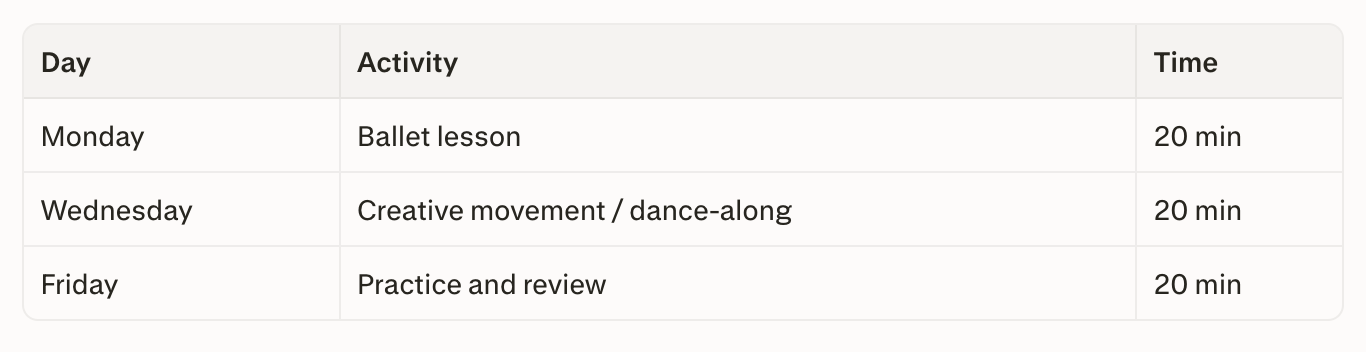
Light schedule (3 days/week, ages 3-7):
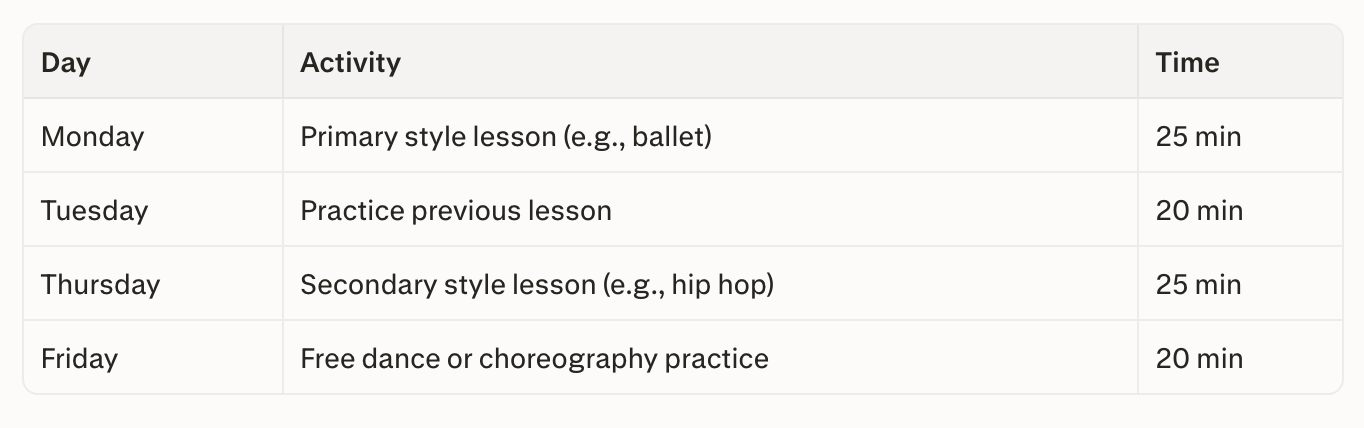
Standard schedule (4 days/week, ages 7-12):
Full schedule (5 days/week, ages 12-17):
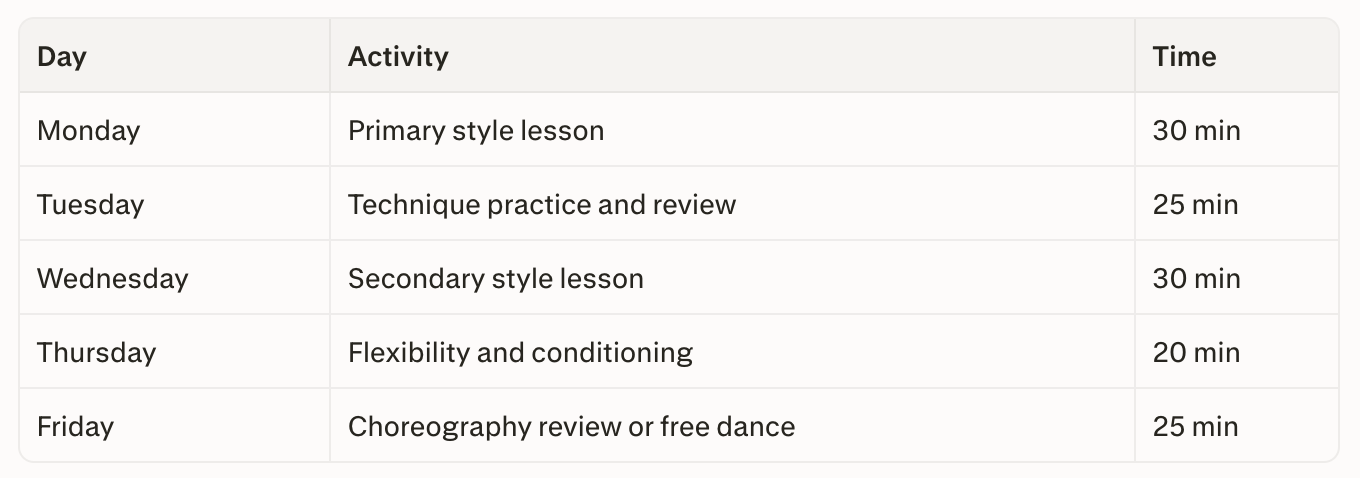
Place dance at a consistent time each day. Many homeschool families find that right after a core academic block works well -- the movement helps reset focus for the next subject.
Step 5: Track Progress and Document Hours
Documentation serves two purposes: it keeps your child motivated by making progress visible, and it provides the records you may need for PE or fine arts credit.
What to Track
Date and duration of each dance session
Style and lesson completed (e.g., "Ballet, Beginner Level 1, Week 4")
Skills practiced (e.g., positions 1-3, tendu, releve)
Notes on progress or areas to revisit
How to Track
A simple spreadsheet or notebook works fine. If you use a platform with built-in progress tracking -- like lesson completion markers and quizzes -- that provides ready-made documentation with minimal effort on your part.
For families using dance as PE credit, describe the physical activity involved rather than just writing "dance." Note cardiovascular work, flexibility, strength, coordination, and balance. This makes the PE classification clearer if you ever need to justify it. Our post on the best homeschool PE option covers documentation strategies in more detail.
Step 6: Plan for Variety and Milestones
A full year of the same lesson format can feel monotonous, even in a subject your child loves. Build in some variety and celebration points.
Quarterly Milestones
Break the year into four quarters and set a small milestone for each:
Q1 (Weeks 1-9): Complete a beginner course or introductory level in the primary style. Celebrate with a family "performance" where your child shows what they have learned.
Q2 (Weeks 10-18): Begin a second style or advance to the next level. Add a weekly "free dance" session where your child picks the music and choreographs their own routine.
Q3 (Weeks 19-27): Deepen technique in the primary style. Introduce flexibility or conditioning work as a complement.
Q4 (Weeks 28-36): Review and consolidate. Learn a performance-ready routine. Hold an end-of-year recital for family -- even a living room performance counts and gives your child a meaningful goal to work toward.
Adding Enrichment
Dance education can extend beyond the lessons themselves:
Watch professional performances together (many are available free online) and discuss what you notice about technique, musicality, and expression.
Learn about dance history -- the cultural origins of ballet, the roots of hip hop in the Bronx, the Appalachian tradition of clogging.
Use printable worksheets to reinforce vocabulary and concepts from lessons.
Keep a dance journal where your child reflects on what they learned, what was challenging, and what they want to work on next.
These enrichment activities also count toward fine arts credit documentation, making your curriculum even more robust.

Putting It All Together
Building a homeschool dance curriculum is simpler than it sounds. Set your goals, choose styles that match your child's age and interests, pick a program that provides structured progression, schedule regular practice, and track what gets done. That is the whole framework.
The most important thing is to start -- even imperfectly. A child who dances three times a week for 20 minutes, following a real curriculum, will develop more skill, confidence, and physical fitness over a school year than most people expect.
If you are looking for a program that handles the curriculum structure for you, YouDance.com offers sequenced courses in five dance genres with built-in quizzes and progress tracking -- all designed for independent homeschool learning. You can try a free sample class to see if it fits your family.