Online Dance Classes: How Kids Can Learn to Dance at Home
Online Dance Classes: How Kids Can Learn to Dance at Home
Whether your family lives far from a dance studio, has a schedule that makes weekly classes nearly impossible, or simply wants a more flexible option, online dance classes have become a genuinely strong choice for kids of all ages.
Over the past several years, the quality of virtual dance instruction has improved dramatically. What used to be a patchwork of YouTube videos and one-off tutorials has grown into structured, curriculum-based programs that teach real technique across multiple styles. Your child can now learn ballet, hip hop, jazz, and more — all from your living room.
This guide covers everything parents need to know: what online dance classes look like, how to choose the right program, and how to make the experience stick.
Why Online Dance Classes Are Worth Considering
For many families, online dance classes started as a backup plan. For plenty of them, it became the preferred option. Here is why.
Flexibility
On-demand programs let your child dance when it works for your family — before school, after dinner, or on a Sunday afternoon. There are no fixed schedules to work around, no classes to miss when life gets busy.
Affordability
A single monthly membership to an online platform typically covers multiple dance styles. Compare that to a traditional studio, where each style — ballet, hip hop, jazz — often comes with its own separate tuition. Online classes can deliver significantly more variety for a fraction of the cost.
Accessibility
Geography matters less when your classes are virtual. Families in small towns, rural areas, and underserved communities can access the same quality instruction as families near major dance studios.
Comfort and Lower Pressure
Some kids thrive without an audience. Learning dance at home removes the performance anxiety that can come with a studio class. Your child can rewind a video, repeat a step as many times as needed, and learn at their own pace.
Family Participation
Many online programs allow the whole family to participate under a single membership. Younger siblings can join in, parents can dance alongside their kids, and the whole thing becomes a shared activity rather than a drop-off errand.
A Safer Content Environment
Dance content online is not all created equal. General platforms like YouTube or social media apps expose kids to age-inappropriate choreography, adult themes, and unfiltered comments. A dedicated dance education platform keeps the content curated, ad-free, and appropriate for children.
What to Expect from Online Dance Classes
If your child has never taken a virtual dance lesson before, here is what a typical experience looks like.
Pre-Recorded vs. Live Classes
Most online dance programs fall into one of two categories:
On-demand (pre-recorded): Video lessons your child can watch and follow along with anytime. These work well for independent learners and busy families.
Live (Zoom-style): Real-time classes with an instructor. These offer more interaction but require scheduling.
On-demand programs tend to offer more flexibility and are the more common format for kids' programs.
Typical Class Structure
A well-designed lesson usually follows a familiar format:
Warm-up to prepare the body
Instruction on new technique or choreography
Guided practice
Cool-down
This mirrors what you would find in a quality in-person studio — the structure just lives on your screen.
Levels, Progress, and Curriculum
Look for programs that organize lessons into a clear sequence. Structured curricula — where each lesson builds on the last — produce better results than a random collection of tutorial videos. Some programs also include quizzes, progress tracking, or achievement milestones to keep kids engaged.

Styles You Can Learn Online
Most platforms cover at least a few of the major genres:
Ballet
Hip hop
Jazz
Contemporary
Clogging or tap
What You Need
Almost nothing. A device (phone, tablet, laptop, or TV), a few square feet of clear floor space, and comfortable clothing. No special equipment, no barre, no studio floors required.
How to Choose the Right Online Dance Program
Not all online dance programs are built the same. Here are the questions worth asking before you subscribe.
Is the Instruction High Quality?
Look for programs created by trained dancers and choreographers — not just popular social media personalities. Credentials matter when you are trying to teach real technique.
Is There a Real Curriculum?
A structured curriculum matters far more than a large video library. A child who follows 215 sequenced lessons will develop real skills. A child who randomly picks videos each week might have fun, but may not actually progress.
Is the Content Safe and Age-Appropriate?
Check whether the platform is ad-free. Look at the music choices and the clothing worn in the videos. Family-focused platforms are intentional about keeping content appropriate for younger children. General platforms may not be.
Does It Offer Multiple Styles?
If your child wants to try hip hop this month and ballet next month, you want a platform that supports exploration without charging extra for each style.
What Does It Cost?
Pricing structures vary:
Monthly: Flexible, but adds up over time
Annual: Better value if you are committed
Lifetime: Best long-term value if you plan to use it for years
Always check whether a single membership covers the whole family or is priced per child.
Is There a Free Trial?
Reputable programs offer a way to try before you commit — a free sample class, a free trial period, or a money-back guarantee. If a platform does not offer any of these, proceed with caution.
What Do Other Parents Say?
Search for parent reviews outside the platform's own website. Look for feedback about curriculum quality, how kids engage over time, and whether the content matches what was advertised.
Online Dance Classes vs. In-Person Studios
Both have real value. Here is a side-by-side look to help you figure out what works for your family.
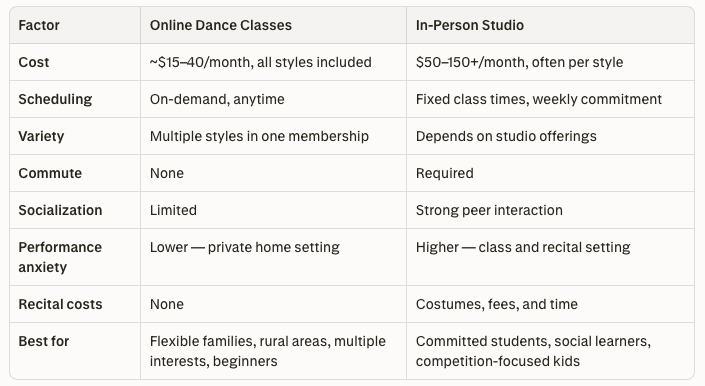
One thing worth noting: these options are not mutually exclusive. Many families use an in-person studio for one style their child is serious about, and an online program to explore other genres affordably. If your child is already interested in homeschool PE and physical activity options, online dance can fit naturally into that broader movement routine.
Popular Dance Styles You Can Learn Online
One of the biggest advantages of virtual dance lessons is the range of styles available. Here is a quick look at what your child might explore.
Ballet
Ballet builds posture, body awareness, coordination, and grace. It is foundational for many other styles. Even kids who never plan to perform benefit from the discipline it develops.
Hip Hop
High energy and endlessly creative, hip hop is one of the most popular styles with kids and teens. It builds confidence, rhythm, and physical coordination in a way that feels less "formal" than classical styles.
Jazz
Jazz dance develops musicality, performance skills, and expression. It blends technical training with entertainment, making it engaging for kids who love being on stage.
Contemporary
Contemporary dance emphasizes emotional expression and creative movement. It is a great fit for kids who prefer storytelling over strict technique.
Clogging and Tap
These rhythm-focused styles are fun, energetic, and surprisingly accessible in small spaces. Clogging in particular is a distinctly American folk tradition that many kids have never tried — and often love.
Platforms like YouDance.com offer all five styles under a single family membership, which makes it easy for your child to explore without any added cost.
Tips for Making Dance Classes from Home Actually Work
Starting is the easy part. Here is how to set your child up for long-term success with dance classes from home.
Create a dedicated dance space.
You do not need much — just a few cleared square feet. Push furniture back, roll up a rug if possible, and designate it as the "dance space." If you have a TV with casting capability, play the lessons on the big screen.
Build it into the routine.
Dance at the same time each day or week. Morning, after lunch, or after dinner all work — the key is consistency. Kids thrive on predictability, and habit formation makes it easier to stay engaged over time.
Let your child choose their style.
Autonomy builds motivation. If your child wants to start with hip hop instead of ballet, let them. Interest-led learning produces better outcomes than top-down direction.
Dance together.
Especially with younger children, joining in makes a huge difference. You do not need to be a dancer — just be willing to look a little silly and have fun.
Celebrate progress, not perfection.
A child who tries a new move and does not nail it on the first attempt is still learning. Focus on effort and improvement rather than flawless execution.
Use the free trial.
If a program offers a sample class or a trial period, use it before paying. What looks good on paper may not be the right fit for your specific child.
Conclusion
Online dance classes offer a flexible, affordable, and genuinely effective way for kids to learn real dance skills — regardless of where you live or what your schedule looks like. With a quality program, your child can build technique, explore multiple styles, and develop confidence, all without leaving home.
YouDance.com offers on-demand classes in ballet, hip hop, jazz, contemporary, and clogging for the whole family, with a structured curriculum, no ads, and age-appropriate content throughout. Try a free sample class to see if it is the right fit for your child.