Online Dance Lessons for Kids: Choosing the Right Program
Online Dance Lessons for Kids: How to Choose the Right Program
The number of online dance lessons for kids has grown dramatically in recent years. What was once limited to a few YouTube channels and the occasional Zoom class has become a full landscape of platforms, apps, subscription programs, and live virtual studios. That is good news for families -- but it also means the process of choosing the right program can feel overwhelming.
Not all online dance programs are built the same way, and not all of them are designed with children in mind. Some are meant for adult hobbyists. Others focus on professional-track dancers. Some offer random videos with no structure, while others provide a sequenced curriculum that builds real skills over time. The difference matters, especially if your child is just starting out.
This guide walks through the key questions to ask, the features that make the biggest difference, and how to find a program that matches your child's age, interest level, and goals.
Live vs. On-Demand: Which Format Is Better?
Before comparing individual programs, it helps to understand the two main formats for online dance lessons.
Live Virtual Classes
Live classes happen in real time, typically over Zoom or a similar platform. A teacher instructs, students follow along, and there is some degree of interaction -- the instructor may offer corrections or encouragement based on what they see on screen.
The advantages are social connection and immediate feedback. The downsides are fixed scheduling, the need for a stable internet connection, and the reality that an instructor watching a grid of small video windows cannot offer the same level of individual attention as they would in a studio.
On-Demand Programs
On-demand lessons are pre-recorded and available anytime. Your child presses play, follows the instructor, and works at their own pace. They can pause, rewind, and repeat sections as many times as needed.
This format trades live interaction for flexibility. There is no schedule to keep, no commute, and no pressure to keep up with a group. For families managing multiple children, homeschool schedules, or unpredictable days, on-demand programs tend to be the most sustainable option.
For a deeper look at how these formats compare, see our guide to virtual dance classes for kids.
What to Look for in Online Dance Lessons for Kids
With dozens of options available, these are the features that separate programs kids actually stick with from ones they abandon after a week.
Age-Appropriate Instruction
This is the single most important factor. A program designed for adults or advanced teens will not work for an eight-year-old, even if the content is labeled "beginner." Look for instructors who speak directly to children, use clear and patient demonstrations, keep lesson segments short, and understand how kids learn movement.
For children under seven, lessons should be 10 to 15 minutes. Ages seven to twelve can handle 20 to 30 minutes. Teens can manage longer sessions, but variety within the lesson still matters for holding attention.
Progressive Structure
Random dance videos are fun, but they do not build skill. The most effective programs organize lessons into a progressive sequence -- each class builds on the previous one, introducing new skills in a logical order. This is what separates a curriculum from a collection of clips.
A well-structured program will have clear levels (beginner, intermediate, advanced), a defined path from one lesson to the next, and some way to mark progress. If you are counting dance toward school credit, this kind of structure also makes documentation straightforward.
Multiple Dance Styles
Kids often do not know what style they will enjoy until they try it. A program that offers several genres -- ballet, hip hop, jazz, contemporary, clogging -- gives your child room to explore without needing separate subscriptions for each style.
Exposure to multiple genres also builds a more well-rounded dancer. A child who tries both ballet and hip hop develops different types of body awareness, musicality, and coordination.
Production Quality
Your child needs to clearly see the instructor's full body and feet. Poor camera angles, dim lighting, or cluttered backgrounds make it harder to follow along. The best programs film in clean studio spaces from thoughtful angles, with clear audio and visible demonstrations.
This is not about flashy production -- it is about whether your child can actually learn from what they are watching.
Progress Tracking
Some form of built-in progress tracking -- completed lessons, quizzes, points, or level advancement -- helps both you and your child see that skills are developing over time. For younger kids especially, visible progress markers (like earning points or completing a level) provide motivation to keep going.
For parents who need documentation for homeschool records, PE credit, or fine arts credit, built-in tracking saves significant time compared to manually logging every session.
Questions to Ask Before You Sign Up
Before committing to a program, run through these questions. They will save you from paying for something that is not a good fit.
Is there a free trial? Most reputable programs offer one. Use it. Watch your child actually do a lesson -- do not just browse the website. A free trial tells you more in ten minutes than any marketing page can.
Who is teaching? Look for qualified dance instructors, not just social media personalities who happen to dance. Teachers who understand child development, proper technique, and how to break down movements for beginners make a significant difference in whether your child learns safely and correctly. The National Dance Education Organization offers useful resources on what quality dance instruction looks like.
What ages is it designed for? A program that says "all ages" often means it was designed for one age group and loosely adapted for others. Programs built specifically for children tend to be more engaging and more effective for kids.
How is the content organized? Look for a clear curriculum map. Can you see what your child will learn and in what order? Or is it a library of unrelated videos? Structure matters more than volume.
What happens when your child finishes? Some programs have a few weeks of content. Others have months or years of progressive material. If your child enjoys the program and wants to continue, you do not want to hit a dead end after two months.
Can siblings share an account? If you have multiple children, check whether the subscription covers the whole family or charges per student. Family pricing can make a meaningful difference in cost.
Comparing Online Dance Lessons for Kids: Format by Format
To help clarify the landscape, here is how the main types of online dance programs stack up:
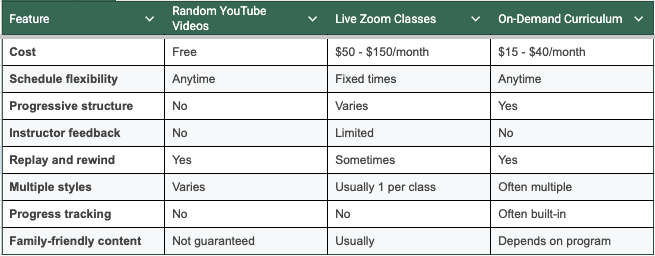
Each format has strengths. YouTube is free and great for exploration. Live classes offer social connection. On-demand curriculum programs offer the best combination of structure, flexibility, and long-term skill development -- which is why they tend to work best for families who want dance to be a consistent part of their child's routine.
Red Flags to Watch For
Not every online dance program deserves your time or money. Watch out for these warning signs:
No clear curriculum. If the program is just a collection of videos with no sequence or progression, your child will not build skills in any systematic way.
Adult-oriented content. Some programs market to "all ages" but feature music, movements, or costuming that is not appropriate for children. Preview content before giving your child access.
No instructor credentials. Dance instruction for kids should come from trained teachers who understand proper technique and child development. Popularity on social media does not equal teaching ability.
No trial period. A program that will not let you try before you buy may not be confident in its own product.
Hidden costs. Watch for programs that charge a base subscription fee but then require additional payments for specific styles, levels, or features. The best programs include everything in one price.
Setting Your Child Up to Succeed
Once you have chosen a program, a few simple habits make the difference between online dance lessons that last and ones that fizzle.
Put it on the schedule. Treat dance like any other subject or activity. A consistent time slot -- even just three days a week for 20 minutes -- builds the habit. Many homeschool families find that placing dance right after a core academic block works well, since the movement helps reset focus.
Create a good space. Your child needs about a five-by-five-foot area of clear floor, a screen they can see clearly, and minimal distractions. Hardwood or tile is ideal, but carpet works for most lesson types.
Let them explore. If the program offers multiple styles, let your child try several before settling on a focus. The goal in the beginning is engagement, not specialization.
Stay nearby but do not hover. Younger children may need help with technology. Older kids benefit from the independence of managing their own practice. Check in on progress regularly, but let the lessons do the teaching.
For more on building dance into a consistent schedule, see our guide to homeschool dance curriculum.
Finding the Right Fit for Your Family
Online dance lessons for kids are not one-size-fits-all. The right program depends on your child's age, what styles interest them, how your family's schedule works, and whether you need documentation for school credit.
The most important criteria are age-appropriate instruction, progressive structure, and a format that fits your daily life. Everything else -- production quality, multiple styles, progress tracking -- is valuable but secondary to those three fundamentals.
YouDance offers on-demand dance courses across five genres -- ballet, hip hop, jazz, contemporary, and clogging -- with over 215 weeks of structured curriculum for ages five to seventeen. Lessons are sequenced by level, include quizzes and progress tracking, and can be done independently on any device. It is worth exploring if you are looking for a program built specifically for young learners.
For a broader look at options available to your family, our guides to online dance classes and dance classes for homeschoolers cover additional formats and considerations.